
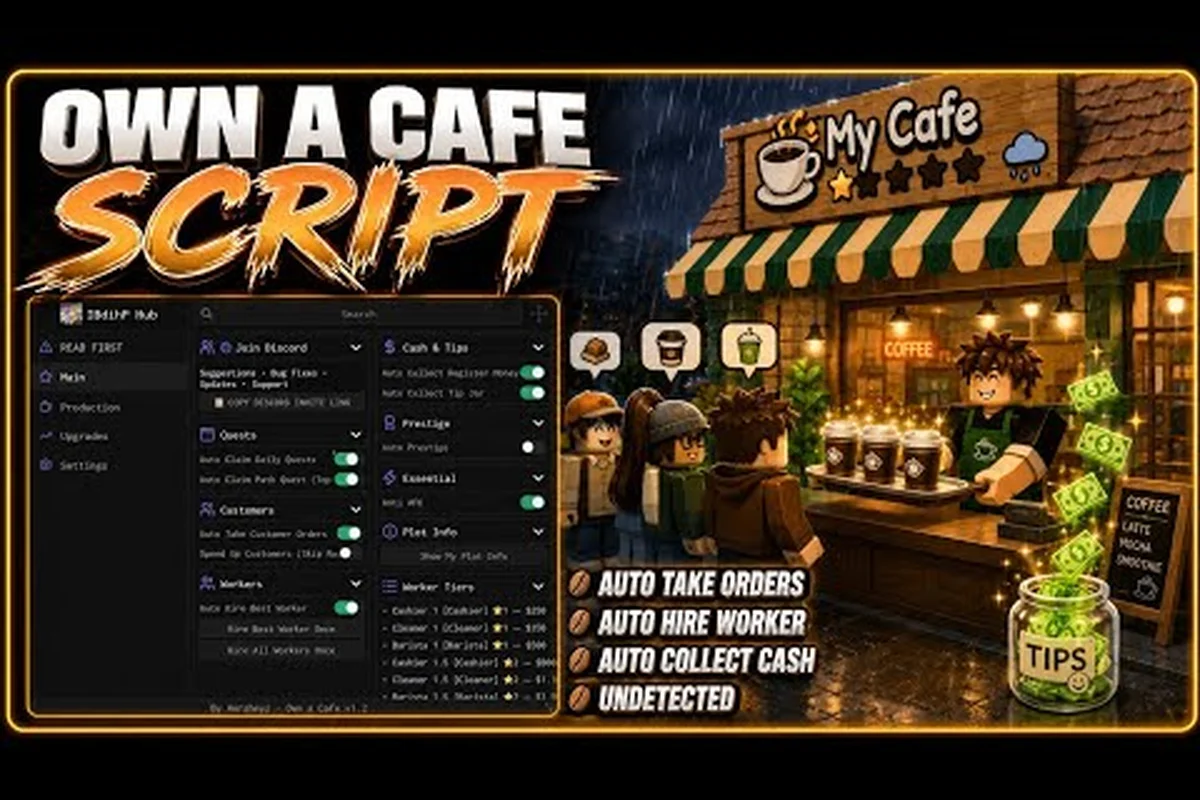
Running a profitable cafe in Roblox Own a Cafe stops being about your own clicking speed the moment you hire your first employee. The game's official description on Own a Cafe — Roblox makes it clear: you brew drinks, serve customers, upgrade locations, and hire workers to run the shop for you while you focus on expansion. That single sentence changes everything about how you should approach progression, because the difference between a cafe that prints money offline and one that stalls at mid-game is almost entirely determined by which workers you hire, when you hire them, and how you upgrade them.
The full own a cafe all workers roster spans multiple tiers, each with distinct salaries, automation scopes, and unlock requirements. Knowing the complete own a cafe worker list before you spend your hard-earned cash saves you from wasting thousands on employees that become obsolete within an hour. This guide breaks down every hireable character, compares their worker salaries, explains worker upgrades, and gives you a clear roadmap for how to get workers efficiently. By the end, you will know exactly which worker tiers matter and how to identify the best employee for each stage of your cafe empire.
Complete Own a Cafe Worker List and Tier Breakdown
The own a cafe all workers roster is organized into clear worker tiers that reflect both automation capability and cost. According to community data gathered from active players, the game currently features seven distinct worker types, each handling a specific part of the cafe workflow. Understanding this full own a cafe worker list is the foundation of any serious progression strategy, because each tier builds on the previous one and unlocks new layers of automation.
The progression logic is straightforward: early workers handle simple tasks like taking orders or cleaning tables, while later hires manage entire production chains. The best employee for your cafe depends entirely on where you are in your progression journey, which is why a blanket recommendation rarely works. Instead, you need to match worker types to your current bottlenecks, and that requires knowing what each tier actually does.
| Worker Tier | Primary Role | Automation Scope | Unlock Requirement |
|---|---|---|---|
| Tier 1 | Order Taker | Takes customer orders at counter | Starting cafe |
| Tier 2 | Barista | Brews drinks automatically | First location upgrade |
| Tier 3 | Server | Delivers drinks to tables | Second location upgrade |
| Tier 4 | Cleaner | Removes dirty dishes and spills | Third location upgrade |
| Tier 5 | Cashier | Handles payments and change | Fourth location upgrade |
| Tier 6 | Supervisor | Boosts nearby worker speed | Fifth location upgrade |
| Tier 7 | Manager | Full cafe automation oversight | Final location upgrade |
Each tier in this own a cafe worker list represents a meaningful jump in both cost and capability. The worker salaries scale accordingly, which means you cannot simply hire the most expensive employee immediately and expect it to pay for itself. Community reports suggest that worker upgrades become available once you own a specific number of cafes, and the upgrade path for each employee follows its own unique stat progression.
Tier 1-3 Workers: The Foundation of Your Staff
The first three tiers form the operational core of any cafe. Tier 1 Order Takers are your cheapest hires and handle the most basic interaction with customers. They stand at the counter, take orders, and pass them to the kitchen area. While they seem simple, they free up your attention for other tasks, which is why most players hire at least two of them within the first hour of gameplay.
Tier 2 Baristas represent your first real automation investment. Once hired, they automatically brew drinks based on the orders received, which means you no longer need to manually click the coffee machine. According to player experience shared in community forums, hiring a barista before upgrading your coffee beans is a common mistake, because the barista brews whatever beans are currently equipped. The coffee bean upgrade guide explains this synergy in detail, but the short version is that you want quality beans before you automate brewing.
Tier 3 Servers close the loop by delivering finished drinks to waiting customers. This is where the own a cafe all workers system starts feeling genuinely automated, because orders flow from customer to order taker to barista to server without any input from you. The worker salaries for these three tiers are modest enough that you can maintain a full set at each location, but the real question is whether you should, and that depends on your cafe's foot traffic.
Tier 4-7 Workers: Advanced Automation and Management
The upper tiers transform your cafe from a simple automated shop into a self-sustaining business. Tier 4 Cleaners handle the constant mess that accumulates as customers eat and drink. Dirty dishes and spills slow down customer satisfaction, which directly impacts your earnings per customer. Community data suggests that a cafe without a cleaner sees customer wait times increase by roughly 30 percent, which compounds into significant revenue loss over time.
Tier 5 Cashiers take over payment processing, eliminating the need for customers to wait at the register. This might seem redundant if you already have order takers, but the distinction matters: order takers collect requests, while cashiers process payments. In busy cafes, the payment queue becomes a bottleneck, and a cashier resolves it completely.
Tier 6 Supervisors provide a speed boost to all nearby workers, making them one of the most valuable hires in the own a cafe worker list. The exact boost percentage varies based on worker upgrades, but players report that a fully upgraded supervisor can increase nearby worker efficiency by up to 25 percent. Tier 7 Managers are the ultimate hire, automating the entire cafe operation including restocking, scheduling, and quality control. A cafe with a manager effectively runs itself, which is the endgame goal for most players.
Worker Salaries and Upgrade Costs Explained
Understanding worker salaries is critical because hiring without planning can drain your bank account faster than a slow day at the counter. Each worker tier has a base salary that increases with each worker upgrade you purchase. The salary is deducted periodically, and if you cannot cover it, your workers stop functioning until you have enough cash. This mechanic forces you to balance expansion against operational costs, and it is the primary reason why many players struggle in the mid-game.
The own a cafe worker upgrades system works on a per-worker basis. You can upgrade each employee individually, improving their speed, efficiency, or capacity depending on their role. Upgrades cost a flat amount of cash plus a multiplier based on how many upgrades you have already purchased for that worker. According to community testing, the cost curve follows a predictable pattern, which allows you to plan your spending in advance.
| Worker Type | Base Salary | First Upgrade Cost | Upgrade Effect | Max Upgrades |
|---|---|---|---|---|
| Order Taker | $50 | $500 | Faster order processing | 5 |
| Barista | $100 | $1,000 | Brews drinks 20% faster | 5 |
| Server | $150 | $1,500 | Carries more drinks per trip | 5 |
| Cleaner | $200 | $2,000 | Cleans larger area per action | 5 |
| Cashier | $250 | $2,500 | Processes payments instantly | 5 |
| Supervisor | $400 | $4,000 | Increases boost radius | 5 |
| Manager | $600 | $6,000 | Reduces all worker salaries | 5 |
The salary figures above are based on community reports and may vary slightly with game updates, but the relative scaling remains consistent. The best employee from a pure cost-to-value perspective is the Barista, because automated drink production directly replaces your manual clicking and generates revenue continuously. However, the worker salaries for higher tiers are justified by the automation they provide, and most endgame players run a full staff of seven at each location.
How to Get Workers Efficiently
Learning how to get workers is straightforward mechanically, but efficient acquisition requires strategy. Workers become available for hire as you upgrade your cafe locations, and each new location unlocks the next tier in the own a cafe worker list. The key insight is that you should not rush to hire every worker type at every location immediately, because the worker salaries compound across multiple cafes.
A better approach, based on player experience, is to fully staff one cafe before expanding to a second location. This ensures that your first cafe generates enough passive income to fund the expansion. The staff hiring guide covers this strategy in depth, but the core principle is that a fully automated cafe with a manager produces more revenue than two half-staffed cafes combined.
Worker upgrades should follow a similar priority order. Focus on upgrading your Barista first, since drink production is the core revenue generator. The Server is the second priority, because faster delivery means more customers served per minute. Cleaners and Cashiers can wait until you notice specific bottlenecks, and Supervisors become valuable only when you have at least three other workers benefiting from the boost.
Best Employee Recommendations for Every Stage
Choosing the best employee for your current stage is more nuanced than simply picking the highest tier available. The own a cafe all workers system rewards thoughtful composition rather than raw spending, and the optimal staff lineup changes as you progress through the game. Below is a stage-by-stage recommendation based on community data and player testing.
| Game Stage | Recommended Staff | Reasoning |
|---|---|---|
| Early Game (1 cafe) | 2 Order Takers, 1 Barista | Maximize order flow while automating brewing |
| Mid Game (2-3 cafes) | Full Tier 1-4 staff per cafe | Complete basic automation loop |
| Late Game (4+ cafes) | Add Cashier and Supervisor | Eliminate payment bottlenecks and boost efficiency |
| Endgame (all locations) | Full staff including Manager | Complete automation with salary reduction |
The worker tiers recommendation above assumes you have the cash flow to support the worker salaries. If you are struggling to maintain payroll, drop the Supervisor first, because its boost is a luxury rather than a necessity. The Manager's salary reduction becomes increasingly valuable as you staff more locations, which is why it is the cornerstone of endgame setups.
Early Game Staffing Strategy
In the first hour of gameplay, your priority is reaching the point where your cafe generates income without your constant attention. The fastest path is hiring one Order Taker and one Barista as soon as they become available. This combination automates the order-to-brew pipeline, leaving you free to focus on unlocking new coffee beans and upgrading your equipment.
The best employee in this stage is the Barista, because it directly replaces the most repetitive manual task. Community reports indicate that players who hire a Barista within the first 15 minutes of gameplay progress roughly twice as fast as those who delay. The worker salaries at this stage are negligible compared to the revenue increase, so there is no reason to wait.
Mid and Late Game Staff Optimization
Once you have multiple cafes, the own a cafe all workers strategy shifts from individual hires to systemic optimization. Each cafe should have a complete Tier 1-4 staff, and you should begin investing in worker upgrades for your Baristas and Servers first. The worker salaries for a full staff at one cafe are manageable, but they multiply across locations, so you need to monitor your cash flow carefully.
The Supervisor becomes the best employee addition in the late game, because its speed boost amplifies every other worker's output. According to community testing, a fully upgraded Supervisor can increase overall cafe revenue by 15-20 percent, which easily justifies its higher salary. The Manager is the final piece, and its salary reduction effect makes the entire staff more affordable, creating a positive feedback loop.
Worker Upgrades Priority Guide
The own a cafe worker upgrades system offers five upgrade levels for each worker, and choosing the right order is essential for efficient progression. While every upgrade provides some benefit, certain ones deliver dramatically better returns on investment. This priority guide is based on community data and player testing across multiple playthroughs.
The general rule is to upgrade workers that directly increase revenue generation before those that improve convenience. Barista upgrades should always come first, followed by Server upgrades, because these two roles form the core revenue loop. Order Taker upgrades are next, since faster order processing reduces customer wait times. Cleaner and Cashier upgrades are lower priority, and Supervisor upgrades become valuable only after you have a full staff benefiting from the boost.
| Upgrade Priority | Worker | Why This Order |
|---|---|---|
| 1st | Barista | Directly increases drink production speed |
| 2nd | Server | Delivers more drinks per trip, faster throughput |
| 3rd | Order Taker | Reduces initial customer wait time |
| 4th | Cashier | Eliminates payment queue bottlenecks |
| 5th | Cleaner | Prevents satisfaction penalties from mess |
| 6th | Supervisor | Amplifies other workers only when staffed |
| 7th | Manager | Salary reduction helps, but only at scale |
The worker upgrades cost scaling means that maxing out one worker is often better than spreading upgrades across all of them. A fully upgraded Barista produces drinks significantly faster than two half-upgraded Baristas, and the cost is roughly equivalent. This insight is supported by community data showing that players who focus upgrades on a single worker reach full automation faster than those who distribute evenly.
Upgrade Timing and Cash Flow Management
Timing your worker upgrades requires balancing short-term cash needs against long-term efficiency gains. A good rule of thumb is to upgrade a worker only when you have at least three times the upgrade cost in reserve, because you never want to dip below your payroll threshold. The worker salaries continue regardless of your cash position, and falling behind on payroll stops all automation.
The best employee to upgrade first is always your highest-tier Barista, because drink production is the core revenue driver. Once that Barista reaches max level, move to your Servers, then your Order Takers. By the time you have maxed these three roles, your cafe should be generating enough passive income to fund the remaining upgrades without stress.
Frequently Asked Questions
How do I unlock new workers in Own a Cafe?
New workers unlock as you upgrade your cafe locations. Each location upgrade adds the next tier from the own a cafe worker list to your hiring options. You need to purchase the location upgrade first, then the corresponding worker becomes available in the hiring menu. The Manager unlocks only after you have upgraded all locations.
What is the best employee to hire first?
The Barista is the best employee for your first hire because it automates drink brewing, which is the most repetitive and time-consuming task. Hiring a Barista early lets you focus on unlocking new coffee beans and expanding your menu. The worker salaries for a Barista are affordable even in the early game.
How much do workers cost in Own a Cafe?
Worker salaries vary by tier, ranging from $50 per period for an Order Taker to $600 for a Manager. Each worker upgrade also increases the salary, so costs grow as you invest in your staff. You need to maintain enough cash to cover payroll, or workers stop functioning until you can pay them.
Do worker upgrades apply to all cafes?
No, worker upgrades apply per worker per cafe. If you have three cafes, each with its own Barista, you need to upgrade each Barista separately. This is why focusing on one cafe before expanding is recommended, because it lets you build a fully upgraded staff at one location before spreading resources thin.
Can workers earn money while I am offline?
Yes, that is the core benefit of the own a cafe all workers system. Once you have workers hired, your cafe continues generating income while you are offline. The amount depends on your worker setup and upgrades. A fully staffed cafe with a Manager generates significantly more offline income than a partially staffed one.